The Executive Playbook 2026
Member: Free | Non-member: Free
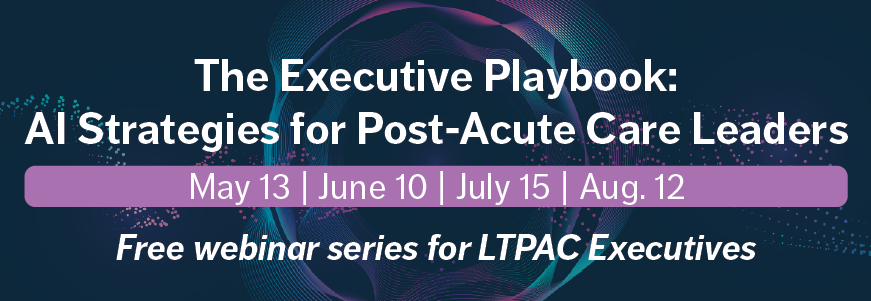
Dates: May 13, 2026 | June 10, 2026 | July 15, 2026 | Aug. 12, 2026
Time: 2 pm ET, 1 pm CT, Noon MT, 11 am PT
Duration: Four webinars, 60-minutes each
AI Strategies for Post-Acute Care Leaders
Develop a strategic roadmap for integrating advanced technologies within a complex regulatory and clinical environment. The Executive Playbook 2026: AI Strategies for Post-Acute Care Leaders is a four-part webinar series designed exclusively for executives in post-acute care, exploring practical applications to optimize organizational performance and efficiency.
Join top industry leaders for this high-impact virtual series as they explore the value and risk of adopting artificial intelligence into the post-acute care environment. Gain actionable strategies to help transform your facility’s standard workflows into a more streamlined proactive and future-ready operational model.
Each webinar includes a live event date but will also be available on-demand for one year. Registration is only required one time to gain access to all four live events, as well as the on-demand bundle.
Upcoming Webinar Descriptions
AI Is Not Coming for Your Job… It’s Coming for Your Paperwork
Date: July 15, 2026
Time: 2 pm ET, 1 pm CT, Noon MT, 11 am PT
Duration: 60 minutes
Speaker: Katelyn Caselli, MHA, OT, RAC-CT, Profility
Artificial intelligence isn’t here to replace clinicians—it’s here to remove the administrative burden that slows them down. In this practical, workflow-driven session, the speaker will share real-world examples of how AI can be safely and effectively integrated into post-acute care processes, particularly for MDS coordinators and case managers. This session is designed to demystify AI and provide actionable strategies you can take back to your organization immediately—helping you chart smarter, reduce administrative strain, and focus more on patient-centered care.
After participating in this webinar, attendees will be able to:
- Describe how artificial intelligence can be applied within post-acute care workflows to reduce administrative burden without replacing clinical decision-making
- Identify practical use cases for AI in MDS coordination and case management, including documentation support and care transition processes
- Explain key considerations for safely and responsibly integrating AI into existing workflows while maintaining compliance and reimbursement integrity
- Recognize at least one actionable strategy to begin incorporating AI into the organization’s processes to improve efficiency and patient-centered outcomes
AI in Post-Acute Care: Separating Value from Risk
Date: Aug. 12, 2026
Time: 2 pm ET, 1 pm CT, Noon MT, 11 am PT
Duration: 60 minutes
Speaker: Paul Minton and Allison Rainey, APRN, FNP-BC, both with MatrixCare
Artificial intelligence is reshaping care delivery across skilled nursing, home health, hospice, and senior living. In this session, the speakers will explore practical, high-value applications—such as documentation support, predictive insights, and workflow automation, while also addressing the risks related to accuracy, clinical safety, compliance, and governance. Gain a clear framework for evaluating where AI can responsibly deliver value and where caution, oversight, and guardrails are essential.
After participating in this webinar, attendees will be able to:
- Describe key applications of artificial intelligence in post-acute care settings
- Differentiate between high-value AI use cases (e.g., documentation support, predictive analytics, workflow automation) and those that may introduce clinical or operational risk
- Identify potential risks associated with AI adoption, including issues related to accuracy, clinical safety, regulatory compliance, and data governance
- Understand how to evaluate AI solutions using a practical framework to determine where implementation is appropriate and where additional oversight and safeguards are needed
On-Demand: AI in Skilled Nursing: Practical Use, Risk, and Operational Impact
Recording Date: May 13, 2026
Duration: 60 minutes
Speakers: Cory Evans, OTR/L, RAC-CT, Jason Daube, and Jeffrey Daube, all with Clinware
Artificial intelligence is already influencing clinical workflows, data exchange, and administrative processes in skilled nursing. The responsibility for leadership is not to follow trends, but to understand where these tools add value, where they introduce risk, and how to implement them in a controlled, accountable way.
During this session, the speakers will spotlight three areas that require immediate attention: how AI is being used in day-to-day operations, how to manage security and interoperability as systems become more connected, and how automation can reduce administrative burden without compromising oversight.
You’ll leave with a clear understanding of what to look for, what to question, and how to move forward in a way that supports your teams and protects your organization.
After participating in this webinar, attendees will be able to:
- Describe practical applications of AI in skilled nursing settings, including clinical, administrative, and data-related workflows
- Discuss responsible and secure implementation of AI tools with vendors
- Recognize the benefits and risks of AI adoption, particularly related to accuracy, oversight, data security, and interoperability
- Identify opportunities to use automation to reduce administrative burden while maintaining compliance and operational integrity
On-Demand: Artificial Intelligence in Skilled Nursing Facilities: A Practical Guide for Clinical Leaders
Recording Date: June 10, 2026
Duration: 60 minutes
Speakers: Eugene Gonsiorek, PhD, NHA, and Genice Hornberger, RN, RAC-CT, both with PointClickCare
Artificial intelligence is entering skilled nursing facilities (SNFs) whether clinical leaders are ready for it or not. From referral review and MDS documentation support to denial analytics and audit tools, AI-powered platforms are being adopted across the industry. Yet for most directors of nursing services (DNSs) and nurse assessment coordinators (NACs), the conversation has been happening around them, not with them.
This webinar cuts through the hype to give clinical leaders a grounded, practical understanding of how AI tools work in skilled nursing settings, where they add value, and where they introduce risk. During this 60-minute session, the speakers will explore why transparency and traceability matter when AI flags a documentation gap or suggests a diagnosis, how to distinguish tools built for SNF workflows from those adapted from acute care, and what governance structures your facility needs before expanding AI use. Most importantly, the speakers will discuss how to protect both residents and your facility when the final responsibility for documentation accuracy always rests with your clinical team.
You will leave with a practical framework for evaluating AI tools, asking the right questions of vendors, and advocating for responsible implementation inside your organizations.
After participating in this webinar, attendees will be able to:
- Describe how artificial intelligence is currently being used in SNFs, including key applications such as documentation support, referral review, and analytics
- Explain the benefits and risks associated with AI tools in SNFs, particularly related to documentation accuracy, compliance, and clinical decision-making
- Discuss the importance of transparency, traceability, and governance when implementing AI, including the role of clinical leadership in oversight and accountability
- Identify key considerations for evaluating AI tools and engaging with vendors, including questions related to workflow fit, data sources, and regulatory implications